

Download the 01.16.26 Dynamic Market Update PDF for advisors’ use with clients
By Kostya Etus, CFA®, Chief Investment Officer, Dynamic Asset Management
The first couple of weeks in 2026 have been eventful, to say the least. We’ve had geopolitical tensions in Venezuela, resurgence of the conflict in Ukraine, Supreme Court rulings on tariffs and a Justice Department probe into Federal Reserve (Fed) Chair Jerome Powell, to name just a few.
And yet, the stock market continues to notch all-time highs. This year, through January 13, the U.S. market is up close to 2% (as measured by the S&P 500). That said, international continues its outperformance, up more than 3%. Meanwhile, the beaten-up small caps have had a massive rally, up over 6%, based on expectations of more rate cuts from the Fed. Similarly, value stocks have outperformed growth stocks this year, signaling potential trends for the year ahead.
It’s worth reflecting on the stupendous year we had in 2025. The U.S. market was up nearly 18%, making it the third year in a row of close-to or more than 20% returns. International markets were the darlings in 2025, finishing the year with over a 33% return. And bonds delivered commendable returns at over 7%. All things considered, it was a good year to be a diversified investor.
In terms of what to expect going forward, we recently received important economic data which will help shape those outlooks:
- Labor Market Data. The U.S. economy added 50,000 jobs in December 2025, below consensus estimates. This is a reinforcement of the Fed’s expectations for a slow-down in the labor market and supports the rhetoric for more interest rate cuts from the Fed in 2026, since rate cuts could provide a boost to the economy. Current market probabilities imply a potential 0.25% cut around mid-year and potentially a second one going into year end. In terms of economic implications, it’s interesting to note the unemployment rate dropped to 4.4%, coming in lower than expectations. This reflects a healthy labor market and economy, meaning we may be slowing down, but we are not necessarily near a recession.
- Inflation Data. We also received our first “relatively clean” consumer price inflation (CPI) report post-government shutdown. The CPI rate for December 2025 came in at 2.7%, matching expectations as well as the reading from November. More importantly, the Core CPI rate, which excludes the more volatile food and energy prices and is the preferred measure by the Fed, came in at 2.6% lower than expectations. This also bodes well for Fed rate cut expectations; they wouldn’t want to lower rates if inflation is too high as lower interest rates often correlate with higher inflation.
In summary, the combination of a softening labor market and steady inflation provided a runway for the stock market to continue to shine in 2026 based on expectations of Fed rate cuts and a continued accommodative monetary policy. This is truly what is important for investors given lower interest rates are beneficial for companies and consumers in terms of more affordable loans, supportive of bond prices (lower rates equals higher prices) and a needed relief for the real estate market. Hence, why the market is largely shrugging off the geopolitical headlines. So far, things look bright for 2026.
Market Lessons from 2025
Hindsight is always 20/20. While 2025 was a great year for overall market returns, the ride to get there was quite volatile. Studying what happened to the market throughout the year can help us glean important insights and perhaps learn lessons about how the market works and how to best navigate it.
Let’s look at some key observations:
- Rough Start. While it may seem like a distant memory,perhaps one of the most impactful reminders about 2025 is that the market reached “bear market” territory (a drop of 20% or more) on April 7, primarily due to tariff announcements. April 4 was one of the worst days in history with the market drop of 6% in one day.
- Strong Finish. It took 54 trading days to recover the losses at the start of the year and then we were off to the races. That said, the market still exhibited three more short-term pullbacks throughout the remainder of the year. It’s staggering to note since the market bottom on April 8, the market rallied nearly 40% through year end.
- Stay the Course. Each year, we are reminded the market is not a smooth ride, and 2025 was no different. Despite the strong outcome, it may come as a surprise that more than 40% of trading days throughout the year were negative. While better than a coin flip, it’s a reminder of how difficult it is to try and time the market. The best approach is often to stay invested for the long-term and ignore the short-term volatility to increase the chances of reaching your investment goals.
Stay diversified, my friends.
S&P 500 Index by the Numbers in 2025
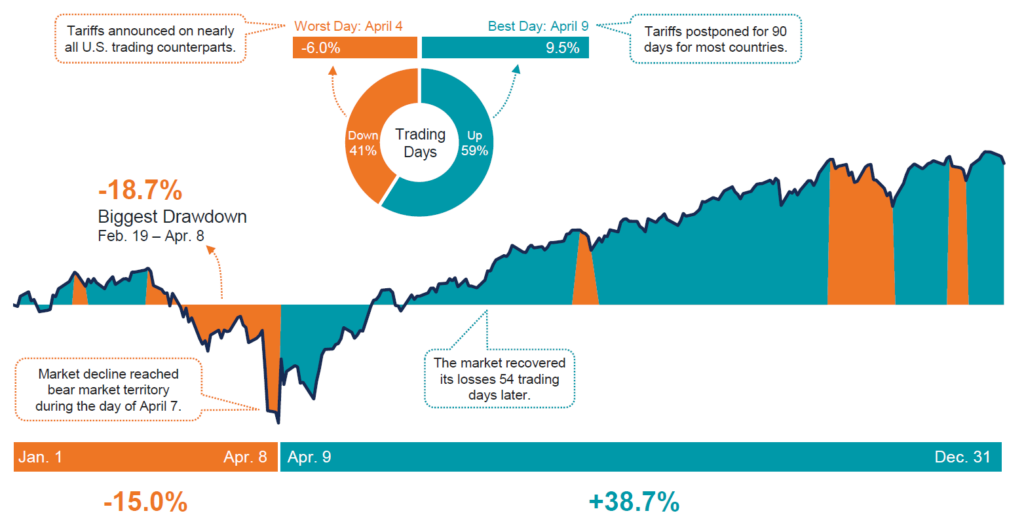
Source: Avantis Investors by American Century Investments, “Monthly ETF Field Guide,”December 2025. Data from 1/1/2025 – 12/31/2025. Source: Bloomberg, Avantis Investors. Past performance is no guarantee of future results.
As always, Dynamic recommends staying balanced, diversified and invested. Despite short-term market pullbacks, it’s more important than ever to focus on the long-term, improving the chances for investors to reach their goals.
Should you need help navigating client concerns, don’t hesitate to reach out to Dynamic’s Asset Management team at (877) 257-3840, ext. 4 or investmentmanagement@dynamicadvisorsolutions.com.
Disclosures
This commentary is provided for informational and educational purposes only. The information, analysis and opinions expressed herein reflect our judgment and opinions as of the date of writing and are subject to change at any time without notice. This is not intended to be used as a general guide to investing, or as a source of any specific recommendation, and it makes no implied or expressed recommendations concerning the manner in which clients’ accounts should or would be handled, as appropriate strategies depend on the client’s specific objectives.
This commentary is not intended to constitute legal, tax, securities or investment advice or a recommended course of action in any given situation. Investors should not assume that investments in any security, asset class, sector, market, or strategy discussed herein will be profitable and no representations are made that clients will be able to achieve a certain level of performance, or avoid loss.
All investments carry a certain risk and there is no assurance that an investment will provide positive performance over any period of time. Information obtained from third party resources are believed to be reliable but not guaranteed as to its accuracy or reliability. These materials do not purport to contain all the relevant information that investors may wish to consider in making investment decisions and is not intended to be a substitute for exercising independent judgment. Any statements regarding future events constitute only subjective views or beliefs, are not guarantees or projections of performance, should not be relied on, are subject to change due to a variety of factors, including fluctuating market conditions, and involve inherent risks and uncertainties, both general and specific, many of which cannot be predicted or quantified and are beyond our control. Future results could differ materially and no assurance is given that these statements or assumptions are now or will prove to be accurate or complete in any way.
Past performance is not a guarantee or a reliable indicator of future results. Investing in the markets is subject to certain risks including market, interest rate, issuer, credit and inflation risk; investments may be worth more or less than the original cost when redeemed.
Investment advisory services are offered through Dynamic Advisor Solutions, LLC, dba Dynamic Wealth Advisors, an SEC registered investment advisor.
Photo: Adobe Stock