

Download the 03.27.26 Dynamic Market Update for advisors’ use with clients
By Kostya Etus, CFA®, Chief Investment Officer, Dynamic Asset Management
As the war in the Middle East continues, so does market volatility. The market (as measured by the S&P 500) experienced its fourth consecutive negative week (through March 20). Yet, if you look at year-to-date (YTD) returns through March 23, the S&P 500 is down less than 4%. Meanwhile, international stocks, value stocks and bonds are down less than 1%. Small caps are up close to 1% on the year. Volatility doesn’t necessarily spell negative returns; it means that daily swings in the markets are more prevalent. And the best way to combat volatility is to stay diversified!
The primary risk in today’s market environment is the uncertainty surrounding the impact of the war on inflation and the economy. While oil prices have stabilized, they remain well above the average levels over the past year. But this oil spike may be different from ones experienced in the past: Energy is a smaller share of consumer spending, the U.S. is more insulated in terms of supply, and the economy is less oil-intensive (less manufacturing dependent). So, the overall impact may be less significant than news headlines would suggest.
In terms of market outlook, investors are still looking to the Federal Reserve (Fed) for guidance. Let’s review three key takeaways from last week’s Fed meeting:
- Rates on Hold. As expected, the Fed kept rates unchanged at 3.5% to 3.75% at their March meeting. Chairman Jerome Powell emphasized the uncertainty surrounding the war in the Middle East and the potential for higher inflation due to increased oil prices was a primary concern to lowering interest rates. Lowering rates tends to put upward pressure on inflation, and the Fed will want to see stability before proceeding with more cuts.
- Economic Projections are Stable. The Fed shared their projections for key economic data points at this meeting. Notably, their estimates for economic growth were revised higher over the next several years, as well as in the long run. Unfortunately, they also revised their inflation estimates higher for 2026 at 2.7% (well above their 2% long term target) but left future estimates unchanged (signaling that an inflation increase may be shorter-term in nature). Lastly, the unemployment rate forecast remained unchanged for 2026, but had a slight uptick in 2027, highlighting that a recession is not expected on the horizon.
- Uncertainty is High. The Fed also released their closely followed “dot plot,” which shows expectations for future rate changes by each Fed member. While the median consensus was for one cut in 2026 and another in 2027, the individual forecasts were all over the board. For example, through 2027 and starting from current levels, three officials see no cuts, four expect a single cut, six see two more cuts, three predict three cuts, one voted for four, and one for five… Not to mention, one predicted a rate hike!
Bottom line: There is too much uncertainty right now. Given how data dependent the Fed is, upcoming inflation reports will be key to try and gain clarity on future steps.
Looking beyond the headlines, investors need to focus on key economic data points, which the Fed is projecting out as stable-to-improving. While uncertainty is driving volatility, it’s reassuring the stock market appears to be holding up, and more importantly, diversified portfolios are delivering their value as expected during tumultuous times.
Reasons Not to Invest
Regardless of whether the market is going up or down, there are always reasons not to invest. It’s as easy as opening your favorite news site and reading the first few headlines. Remember, bad news sells a lot better than good news. But the main question is, how much impact do geopolitical or even economic events really have on long-term market returns?
The chart below looks at each decade over the past 50 years and highlights some of the key events that could have been reasons to not invest in those years. It then shows the market return that year and illustrates how an investment would grow if held to today. Let’s review the results:
- Always a Reason. There are a wide range of economic, environmental and geopolitical events on the list including high inflation, the Cold War and the housing bubble. While each year lists three significant events, there could be many missing. Looking at the list, any one of these events could derail the market — yet annual returns tell a different story.
- Market is Resilient. In all the years evaluated, the stock market ended the year in positive territory. In fact, all the years posted double-digit returns. While this is a small sample size, the point of the story is these major events did not derail markets. If investors got out of the market because of one of these events, or due to a short-term market drop caused by the event, they may have missed out on significant upside on the rebound.
- It’s a Long-Term Game. The right column (Growth of $10,000) shows the number gets exponentially larger as you go back in history. The power of compounding cannot be overlooked, but it only works if you stay invested. Shifting in and out of the market based on headlines can have a detrimental effect on long-term returns. Staying diversified and invested for the long-term is the best way to increase the chances of reaching investment goals.
Stay diversified, my friends.
Staying Invested Despite Negative News
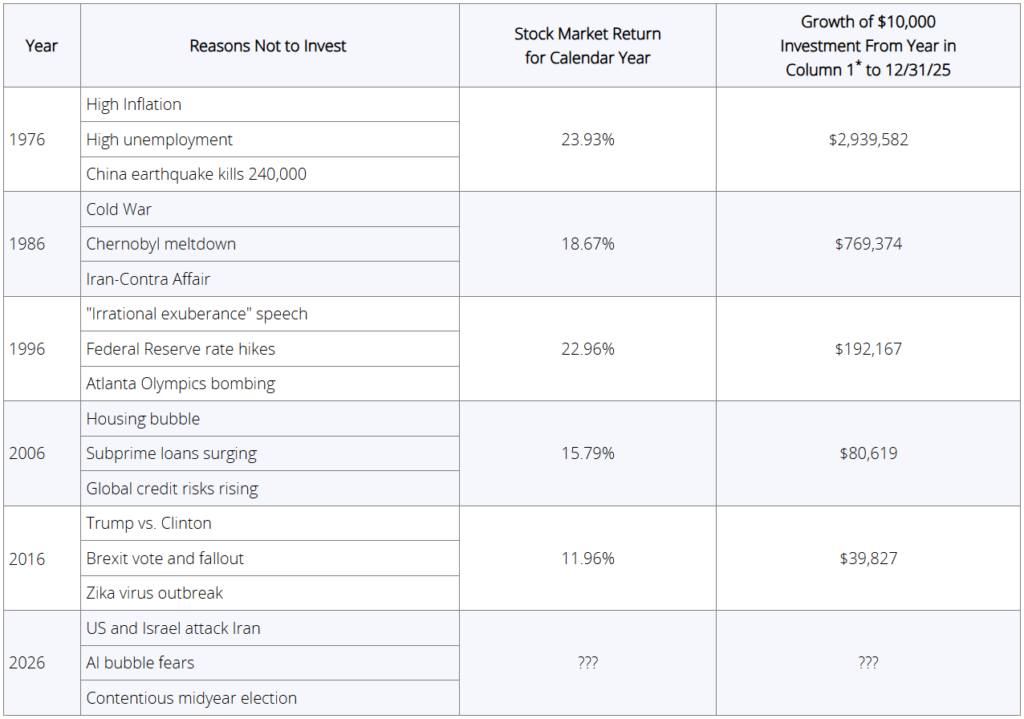
Source: Hartford Funds “There Are Always Reasons Not to Invest,” January 2026. Past performance does not guarantee future results. *Assumes an initial investment of $10,000 in stocks beginning on January 1 of the year in column 1 through December 31, 2025, reinvestment of dividends and capital gains, and no taxes or transaction costs. Stocks are represented by the S&P 500 Index, which is a market capitalization-weighted price index composed of 500 widely held common stocks. Indices are unmanaged and not available for direct investment. For illustrative purposes only. Data Sources: Morningstar and Hartford Funds, January 2026.
As always, Dynamic recommends staying balanced, diversified and invested. Despite short-term market pullbacks, it’s more important than ever to focus on the long-term, improving the chances for investors to reach their goals.
Should you need help navigating client concerns, don’t hesitate to reach out to Dynamic’s Asset Management team at (877) 257-3840, ext. 4 or investmentmanagement@dynamicadvisorsolutions.com.
Disclosures
This commentary is provided for informational and educational purposes only. The information, analysis and opinions expressed herein reflect our judgment and opinions as of the date of writing and are subject to change at any time without notice. This is not intended to be used as a general guide to investing, or as a source of any specific recommendation, and it makes no implied or expressed recommendations concerning the manner in which clients’ accounts should or would be handled, as appropriate strategies depend on the client’s specific objectives.
This commentary is not intended to constitute legal, tax, securities or investment advice or a recommended course of action in any given situation. Investors should not assume that investments in any security, asset class, sector, market, or strategy discussed herein will be profitable and no representations are made that clients will be able to achieve a certain level of performance, or avoid loss.
All investments carry a certain risk and there is no assurance that an investment will provide positive performance over any period of time. Information obtained from third party resources are believed to be reliable but not guaranteed as to its accuracy or reliability. These materials do not purport to contain all the relevant information that investors may wish to consider in making investment decisions and is not intended to be a substitute for exercising independent judgment. Any statements regarding future events constitute only subjective views or beliefs, are not guarantees or projections of performance, should not be relied on, are subject to change due to a variety of factors, including fluctuating market conditions, and involve inherent risks and uncertainties, both general and specific, many of which cannot be predicted or quantified and are beyond our control. Future results could differ materially and no assurance is given that these statements or assumptions are now or will prove to be accurate or complete in any way.
Past performance is not a guarantee or a reliable indicator of future results. Investing in the markets is subject to certain risks including market, interest rate, issuer, credit and inflation risk; investments may be worth more or less than the original cost when redeemed.
Investment advisory services are offered through Dynamic Advisor Solutions, LLC, dba Dynamic Wealth Advisors, an SEC registered investment advisor. Photo: Adobe Stock