

By Brian Bowen, Director of Advisor Integration
If you run an independent advisory firm, you’ve seen the news: Fidelity announced existing RIAs using its custody platform must maintain at least $100 million in client assets custodied at Fidelity by June 30, 2027, or begin transitioning off the platform.
For firms below that threshold, the announcement creates a real business decision. Moving assets to another custodian can be disruptive, and no advisor wants to spend months repapering accounts when that time could be spent serving clients or growing the business.
But the deadline also gives firms time to evaluate their options before making a move.
At Dynamic, we work with independent advisors who are thinking through questions like these: How do I grow without adding unnecessary complexity? Where do I need more operational support? How do I protect my independence as my practice evolves?
Fidelity’s announcement brings those questions into sharper focus. The right response will depend on a firm’s size, growth prospects, operating model and long-term goals.
Start with the Right Numbers
The first thing to understand is how Fidelity measures the $100 million threshold. The requirement applies to assets custodied directly on Fidelity’s platform, not the firm’s total assets under management.
For example, a firm with $150 million in total AUM but only $75 million at Fidelity would fall below the threshold. A firm with $85 million entirely at Fidelity would have a smaller gap to address.
That distinction matters, particularly for firms that already work with multiple custodians.
Before considering a transition, take a close look at your existing relationships and the assets held at each one. Determine how much of the gap could realistically be addressed through organic growth or consolidation, taking client preferences and account-specific considerations into account.
You may find the problem is smaller than it first appeared. Or you may discover the deadline is a useful reason to reconsider your current business model.
Four Paths Worth Considering
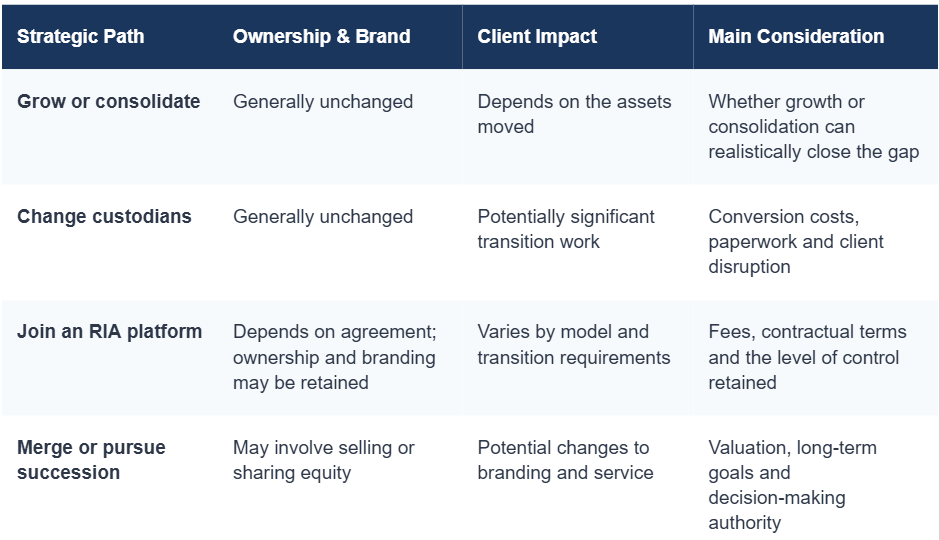
There isn’t one right answer for every firm. In practice, most advisors affected by the change will want to evaluate four possibilities.
Path 1: Grow or Consolidate
If you’re reasonably close to the threshold, staying with Fidelity may be a viable option.
Start by examining your existing custodial relationships. If you hold assets elsewhere, consider whether moving some of them to Fidelity makes sense for your clients and your business. Consolidation could help close the gap, although it shouldn’t be pursued simply to meet a minimum.
Organic growth is another possibility. If your firm is already growing steadily, you can model whether that growth is likely to get you to $100 million within the available time.
The key is to work with realistic projections rather than assume that a strong year will solve the problem. If the numbers don’t support staying, it’s better to know that sooner rather than later.
Path 2: Move to Another Custodian
For some firms, moving to a different custodian will be the most straightforward long-term solution.
Schwab, Altruist, LPL and other providers may be worth evaluating, depending on the firm’s size, service needs and business model. Each has its own requirements, technology, pricing and support structure, so the comparison should go beyond minimum asset levels.
The advantage is you can continue operating independently under your existing business structure. The trade-off is the work involved in changing custodians, including account transfers, paperwork, technology adjustments and client communication.
A conversion is manageable with proper planning, but it isn’t cost-free. Advisors should weigh the disruption against the longer-term benefits of the alternative.
Path 3: Affiliate with an Established RIA Platform
This option deserves consideration from advisors who want to retain their independence but would prefer not to manage every aspect of the business themselves.
Depending on the platform and its agreement with Fidelity, affiliation may allow an advisor to continue using Fidelity’s custody infrastructure while gaining access to additional operational resources. Those resources might include compliance support, technology, trading services and back-office assistance.
Some models also allow advisors to retain ownership of their firms, operate under their existing brands or DBAs, and maintain substantial control over client relationships.
The details matter. Ownership rights, fees, decision-making authority and the degree of operational control vary by arrangement. Advisors should understand exactly what they are agreeing to before making a change.
For the right firm, affiliation can provide a way to address the custody issue while also improving the business’s operating model. Instead of simply solving a deadline problem, the advisor may be able to reduce administrative demands and spend more time on clients and growth.
Path 4: Consider a Partnership, Merger or Succession Plan
The Fidelity announcement may also prompt some owners to revisit a question they’ve been putting off: What do I want this business to look like five or 10 years from now?
A merger, equity partnership or succession arrangement may make sense for an advisor who wants to share responsibility, access additional resources or begin planning an eventual exit.
These arrangements can involve significant changes to ownership, compensation, branding and decision-making. They aren’t necessarily the right response to a custody requirement alone.
But if you’re already considering a transition, this may be a good opportunity to evaluate whether a larger strategic change would better serve your goals.
Compare the Trade-Offs, Not Just the Custody Options
Choosing a path requires more than determining which provider will accept your assets. You also need to consider ownership, the client experience, and how much of the business you want to manage yourself.
There’s another question worth asking: How much of your time is going toward running the business rather than advising clients?
- If you remain fully independent: You retain direct control over your operations, but you also remain responsible for coordinating the technology, compliance, vendor relationships and administrative work required to run the firm.
- If you join a platform affiliation: You may be able to delegate some of those responsibilities while retaining ownership and client relationships. The benefit depends on what the platform actually provides and how well its services fit your practice.
- If you explore a merger or succession: You can shift even more responsibility to another organization, but it may also require you to give up some ownership or control.
None of these choices is inherently better than the others. The important thing is to understand what you’re gaining, what you’re giving up and whether the arrangement fits the kind of firm you want to build.
Questions to Answer Before June 2027
Rather than treating the deadline as a paperwork problem, use it to evaluate the business itself:
1. How realistic is our path to $100 million at Fidelity? Look at your current assets, expected growth, client retention and the likelihood of consolidating assets. Build a projection based on reasonable assumptions, not best-case scenarios.
2. Where do we need more support? If you’re spending too much time coordinating technology, managing compliance, or handling administrative work, consider whether your current operating model will support the next stage of growth.
3. How much independence do we want to retain? Independence can mean different things to different advisors. For some, it means maintaining complete control over the business. For others, it means owning the firm and controlling the client experience while relying on outside partners for infrastructure. Be clear about which elements matter most to you.
4. What do we want the business to look like in five or 10 years? The best decision isn’t necessarily the one that gets you through June 2027 with the least disruption. It’s the one that puts your firm in a stronger position for the years that follow.
The Bottom Line
Fidelity’s $100 million minimum is a meaningful change for firms that fall below the threshold. It deserves attention, and waiting until the deadline approaches will only make the decision harder.
Advisors have time to assess their numbers, compare alternatives and decide what makes sense for their businesses.
Your next move should be your decision. Let’s talk about what’s on the horizon for you and your firm and discuss the options that best align with your goals.
For an objective, confidential conversation, contact Dynamic at (888) 997-4212 or joinus@dynamicadvisorsolutions.com. Or, schedule a confidential conversation today.
Investment advisory services are offered through Dynamic Advisor Solutions, LLC, dba Dynamic Wealth Advisors, an SEC registered investment advisor.
Photo: Adobe Stock