

Download the 08.28.26 Dynamic Market Update for advisors’ use with clients
By Kostya Etus, CFA®, Chief Investment Officer, Dynamic Asset Management
After reaching all-time highs by mid-August on the back of strong corporate earnings, the markets took a breather last week. The S&P 500 had its first down week in nearly a month during a roller-coaster ride for longer-term interest rates. Yields increased when they should have been coming down. We had a weak job report for July, followed by moderating inflation and reduced expectations for rate hikes. This should have spelled lower rates, however, the 30-year Treasury yield reached its highest level in almost 20 years.
Despite the recent weakness through Aug. 8, 2026, the U.S. market is up an even 13% on the year. While that’s generally considered an unlucky number, I’m sure investors will overlook this in favor of achieving double-digit gains. And most importantly, the great rotation continues with small caps beating large (+22%), value in line with growth (+13%), international markets beating domestic (+15%), and real estate beating stocks (+14%). Truly a great year for diversified portfolios and long-term investors.
To help gauge where rates may go from here, let’s review the factors behind the upward pressure:
- Geopolitics. Remember when oil fell below $70 to start July? Well, we are back to the $80-$90 range in August. Continued uncertainty about the war in the Middle East and future constraints for the Strait of Hormuz are creating volatility for oil prices, muddying the outlook for inflation. That said, we have seen inflation come down in recent months. If the data continues to support this trend, we should see longer-term rates begin to moderate.
- Global Yields. Inflation pressures in 2026 are not a U.S. phenomenon. The war has elevated inflation for much of the globe — and with it increased long-term yields higher for many of the world’s largest economies. For example, the yield on 10-year Japan bonds hit the highest level in about 30 years, while Germany’s 30-year yields are the highest in 15 years. Any resolution for the Middle East conflict would be welcomed to help reverse this trend.
- Bond Mechanics. A bond yield is impacted by the “term premium,” which means compensation for holding a bond for longer. With persistent rate uncertainty this year, investors are requiring higher compensation for longer-term bonds. As uncertainty decreases and the path for the Federal Reserve (Fed) rate becomes clearer, we should start to see longer-term rates come back down.
In terms of what to expect through year end for stocks, there are some headwinds and tailwinds on the horizon. A healthy reminder is that markets don’t always move up. Aside from the rate woes, we are entering a seasonally weaker couple months for stocks while uncertainty is building around mid-term elections. However, once we make it over the hump and into the holiday season, momentum tends to turn positive and the skies often brighten for the always welcomed “Santa Claus rally” when consumers open their wallets and the markets rejoice.
Not So Magnificent
The “Magnificent 7” (Mag 7) have been the standout performers over the past couple years as the primary benefactors of the AI boom. They include Nvidia (NVDA), Microsoft (MSFT), Apple (AAPL), Alphabet/Google (GOOG), Amazon (AMZN), Meta Platforms/Facebook (META) and Tesla (TSLA).
These mega-cap, technology-stock darlings have been the talk of the town, but their growth and outperformance led to extreme levels of market concentration and nosebleed valuations entering 2026. Questions began like, “Has their performance been overdone?” and “Can they keep going given lofty expectations?”
The chart below examines 2026 relative returns and offers some answers. Here are the key insights:
- The Magnificent 7. The Mag 7 started their run in 2024 with the introduction of the AI boom. These companies possessed the capital, digital infrastructure and scale required to build and monetize AI technologies. They drove most of market returns through the next two years, leading to a massive 36% concentration in the S&P 500 by late 2025. This left little room for the other 493 companies.
- Breadth Widening. Things changed in 2026 as other areas of the market started to catch up. Other sectors and industries outside of tech began adopting AI technologies and growing their businesses and earnings. Meanwhile, the Mag 7 earnings began to normalize and come down to earth. This has resulted in what is being called a “Great Rotation” as smaller, more value-focused stocks started to outperform.
- Markets are Cyclical. As the chart shows, essentially every other asset category is beating the Mag 7 through the first half of the year. Market cyclicality dictates that no one stock (or subset of stocks) can perpetually appreciate; there is often an eventual reversal, which is playing out with this shift in market leadership. This is yet another case of the importance of staying diversified among various asset classes and invested for the long term.
Stay diversified, my friends.
Magnificent 7 vs. All
January 1 – June 30 Relative Return Spread of Various Groups to Mag 7
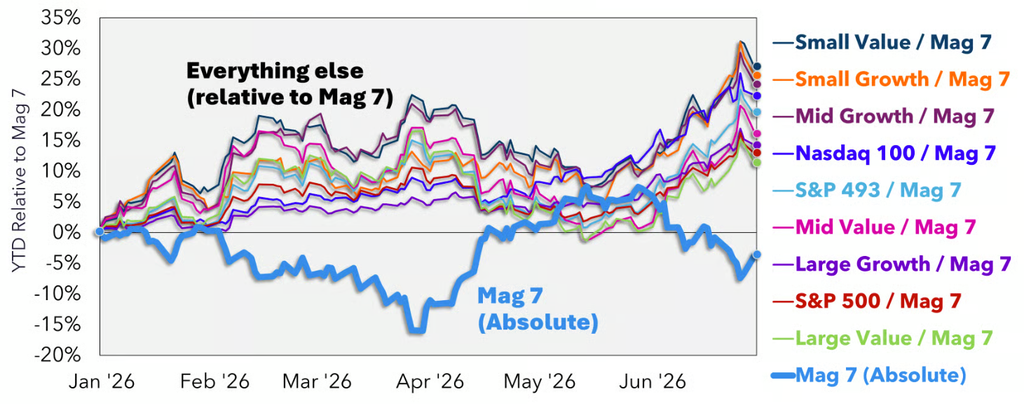
Source: Compound Media, data via Bloomberg Finance L.P, original chart idea via Koyfin on X.com. Data as of 06/30/2026. https://chartkidmatt.com/p/10-reasons-to-be-bullish
As always, Dynamic recommends staying balanced, diversified and invested. Despite short-term market pullbacks, it’s more important than ever to focus on the long-term, improving the chances for investors to reach their goals.
Should you need help navigating client concerns, don’t hesitate to reach out to Dynamic’s Asset Management team at (877) 257-3840, ext. 4 or investmentmanagement@dynamicadvisorsolutions.com.
Disclosures
This commentary is provided for informational and educational purposes only. The information, analysis and opinions expressed herein reflect our judgment and opinions as of the date of writing and are subject to change at any time without notice. This is not intended to be used as a general guide to investing, or as a source of any specific recommendation, and it makes no implied or expressed recommendations concerning the manner in which clients’ accounts should or would be handled, as appropriate strategies depend on the client’s specific objectives.
This commentary is not intended to constitute legal, tax, securities or investment advice or a recommended course of action in any given situation. Investors should not assume that investments in any security, asset class, sector, market, or strategy discussed herein will be profitable and no representations are made that clients will be able to achieve a certain level of performance, or avoid loss.
All investments carry a certain risk and there is no assurance that an investment will provide positive performance over any period of time. Information obtained from third party resources are believed to be reliable but not guaranteed as to its accuracy or reliability. These materials do not purport to contain all the relevant information that investors may wish to consider in making investment decisions and is not intended to be a substitute for exercising independent judgment. Any statements regarding future events constitute only subjective views or beliefs, are not guarantees or projections of performance, should not be relied on, are subject to change due to a variety of factors, including fluctuating market conditions, and involve inherent risks and uncertainties, both general and specific, many of which cannot be predicted or quantified and are beyond our control. Future results could differ materially and no assurance is given that these statements or assumptions are now or will prove to be accurate or complete in any way.
Past performance is not a guarantee or a reliable indicator of future results. Investing in the markets is subject to certain risks including market, interest rate, issuer, credit and inflation risk; investments may be worth more or less than the original cost when redeemed.
Investment advisory services are offered through Dynamic Advisor Solutions, LLC, dba Dynamic Wealth Advisors, an SEC registered investment advisor.
Photo: Adobe Stock