

Download the 11.06.26 Special Market Update for advisors’ use with clients
By Kostya Etus, CFA®, Chief Investment Officer, Dynamic Asset Management
It was an eventful week as Democrats swept both chambers of Congress in the 2026 midterm elections on Tuesday. The initial reaction was a powerful relief rally on Wall Street with the market (S&P 500) gaining nearly 2% on Wednesday. The strong performance was largely driven by the removal of political uncertainty as well as a sharp decline in the price of oil after Vice President JD Vance blamed the Iran war for Republican losses. Oil prices fell by more than 8% from over $100 per barrel down to $88, as investors anticipated the shift in congressional control could help the resolution of tensions in the Middle East and keep inflation contained.
That quickly reversed on Thursday with the market falling by a whopping 4% as fears of a data-center slowdown pushed investors away from technology stocks. This was perhaps an overreaction as investors “bought the dip” on Friday with a strong reversal for the market of about 1% at midday. Additional market support was granted by a strong labor report with the U.S. economy adding 165,000 jobs in October, well above expectations, while the unemployment rate fell to a healthy 4.1%. This represents relief for investors who believed the economy was slowing down.
While we don’t know what the future will bring, there are a few potential market implications to consider based on election results:
- Relief Rally. The potential of a gridlocked government has an optimistic tilt. Historically, a divided government is favored by markets because it minimizes the impact of sweeping, unpredictable regulatory overhauls. While Democrats flipped Congress, President Donald Trump maintains veto power. This ensures a more disciplined policy outlook and less surprises for investors to worry about.
- Lower Rates. As oil prices came down, so did inflation expectations, and in turn interest rates dropped. Bond traders also adjusted for expectations of lower fiscal spending, a reduced deficit and less government debt issuance. Furthermore, anticipation of less aggressive fiscal stimulus caused the U.S. dollar to weaken. All signs point to the potential for lower rates and tailwinds for bonds moving forward.
- AI Complications. In addition to Senate and House victories, Democrats overturned key governor races in states like Texas and Ohio, creating frictions for tech infrastructure. This could create project delays for datacenters and overall pushback for power grid allocation. This could put into question the amount of capital being poured into AI infrastructure and potentially hinder the lofty returns that investors expect.
While some uncertainty remains, the resolution of midterm elections helps pave the path for stronger stock and bond markets moving into the cyclically strong holiday months as investors have more clarity and the potential for lower inflation and interest rates.
Election Cycle Sweet Spot
We know that everything in the markets is cyclical, but did you know there is cyclicality related to elections? With the midterm elections in the rearview mirror, what can we expect for the markets moving forward based on history? The chart below shows what the stock market has done on average six months prior to midterm elections and six months after, going back to 1970. It then compares this performance to non-midterm elections years. The takeaways:
- Weakness Before. We see the six months leading up to midterms tends to be relatively weak and generally looks like a flat market. Interestingly, this flat type of market is what we’ve experienced this year since about May, or roughly for the last six months! This is attributed to uncertainty around the election and what implications it could have on policy, taxes, spending, etc. Investors wait in a holding pattern to gain clarity.
- Strength After. But as soon as the election happens and the skies clear, the markets tend to spike upwards. The result of the election isn’t the important factor. The market doesn’t care whether Democrats or Republicans are in control, it cares that uncertainty subsides and fundamental factors like earnings growth regain control of investor expectations.
- Staying Invested is Key. Perhaps the most important concept in the chart is that whether we are in a midterm year or not, whether we are before or after the election, market returns are generally upward sloping. Sitting on the sidelines or trying to time the market often results is below-average performance. It is always prudent to ignore the noise, stay diversified and stay invested for the long-term.
Stay diversified, my friends.
Market Performance around Midterm Elections
S&P 500 Total Return Performance Since 1970, Indexed to Midterm Date
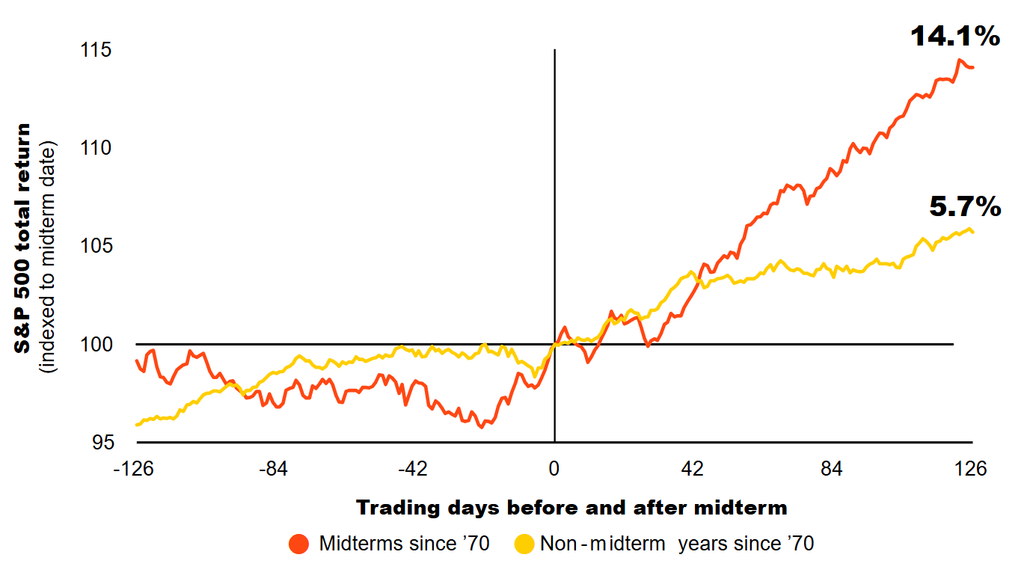
Source: Bloomberg, data as of Aug. 13, 2026. Based on average S&P total return since 1970 indexed to election dates or hypothetical election dates. Midterm years as follows: 1970, 1974, 1978, 1982, 1986, 1990, 1994, 1998, 2002, 2006, 2010, 2014, 2018, 2022. The “0” on the x-axis represents the Midterm/Presidential election date, which falls on the first Tuesday in November. In non-election years, hypothetical election dates were used. Month approximations based on average of 21 trading days in a month. Y-axis numbers represent total return of approximately six months before and after a midterm indexed to midterm date, with the value of the midterm date being 100. Index performance is for illustrative purposes only. Index performance does not reflect any management fees or expenses. Indexes are unmanaged and one cannot invest directly in an index. Past performance does not guarantee future results.
As always, Dynamic recommends staying balanced, diversified and invested. Despite short-term market pullbacks, it’s more important than ever to focus on the long-term, improving the chances for investors to reach their goals.
Should you need help navigating client concerns, don’t hesitate to reach out to Dynamic’s Asset Management team at (877) 257-3840, ext. 4 or investmentmanagement@dynamicadvisorsolutions.com.
Disclosures
This commentary is provided for informational and educational purposes only. The information, analysis and opinions expressed herein reflect our judgment and opinions as of the date of writing and are subject to change at any time without notice. This is not intended to be used as a general guide to investing, or as a source of any specific recommendation, and it makes no implied or expressed recommendations concerning the manner in which clients’ accounts should or would be handled, as appropriate strategies depend on the client’s specific objectives.
This commentary is not intended to constitute legal, tax, securities or investment advice or a recommended course of action in any given situation. Investors should not assume that investments in any security, asset class, sector, market, or strategy discussed herein will be profitable and no representations are made that clients will be able to achieve a certain level of performance, or avoid loss.
All investments carry a certain risk and there is no assurance that an investment will provide positive performance over any period of time. Information obtained from third party resources are believed to be reliable but not guaranteed as to its accuracy or reliability. These materials do not purport to contain all the relevant information that investors may wish to consider in making investment decisions and is not intended to be a substitute for exercising independent judgment. Any statements regarding future events constitute only subjective views or beliefs, are not guarantees or projections of performance, should not be relied on, are subject to change due to a variety of factors, including fluctuating market conditions, and involve inherent risks and uncertainties, both general and specific, many of which cannot be predicted or quantified and are beyond our control. Future results could differ materially and no assurance is given that these statements or assumptions are now or will prove to be accurate or complete in any way.
Past performance is not a guarantee or a reliable indicator of future results. Investing in the markets is subject to certain risks including market, interest rate, issuer, credit and inflation risk; investments may be worth more or less than the original cost when redeemed.
Investment advisory services are offered through Dynamic Advisor Solutions, LLC, dba Dynamic Wealth Advisors, an SEC registered investment advisor.
Photo: Adobe Stock