

Download the 06.12.26 Dynamic Market Update for advisors’ use with clients
By Kostya Etus, CFA®, Chief Investment Officer, Dynamic Asset Management
After a sluggish first quarter, the markets have roared back in the second. Through the end of last week (June 5), the U.S. market, as measured by the S&P 500, is up more than 8% on the year. Interestingly, this has been a healthy rebound in terms of breadth of market performance, as many of the market rotations remain intact, including:
- Small-cap stocks, up nearly 15%, outperforming large-caps
- International markets, up nearly 13%, outperforming domestic
- Real estate up nearly 11%, outperforming stocks
In fact, it’s been such a great run that we were on track for 10 consecutive weeks of gains for the S&P 500 before a large sell-off on June 5. The cause of the pullback was a strong job growth report that blew past projections. While seemingly great news for the economy, as it signals a solid foundation for growth, it was negatively received my investors.
The combination of an improving labor market and continued energy-fueled inflation concerns from the ongoing war in the Middle East prompted fear of potential interest rate hikes from the Federal Reserve, leading to uncertainty and volatility for the markets.
Let’s look past the headlines and evaluate the data to get a clearer picture:
- Labor Market Strength. The U.S. Bureau of Labor Statistics reported the addition of 172,000 new jobs in May, well above economist projections of 85,000. This is a back-to-back win for the labor market as the April report was upwardly revised to a gain of 179,000 jobs. Combined with March, it results in the strongest three-month average since early 2024. Furthermore, the job growth was broadly diversified across various sectors, reinforcing a more durable foundation for growth. Lastly, the unemployment rate remained unchanged at 4.3% for a third consecutive month, reinforcing stability of the labor market.
- Corporate Earnings. While the initial market reaction to the labor numbers was negative, it’s important for investors to consider the longer-term impacts of a strengthening economy. One of the primary considerations is a supportive backdrop for corporate earnings growth and more specifically, the potential of a broadening of market leadership beyond the mega-cap technology names which have dominated the past few years. FactSet reports first quarter corporate earnings grew by nearly 29% over the same quarter a year earlier. That’s the highest growth rate we have seen since late 2021, and the sixth consecutive quarter of double-digit growth — certainly supportive of a strong stock market.
- Interest Rates. The Fed has a difficult job ahead of them. Uncertainty continues to loom around the Middle East conflict and its impact on longer-term inflation, while the economy appears to be regaining its job market footing. These signs may point to potential interest rate hikes to curb inflation and keep the economy from overheating. The upcoming Fed meeting, June 16-17, will be the first with the new chair Kevin Warsh at the helm. He will most likely not want to make any drastic moves, and expectations are for no rate changes at this meeting. That said, market expectations for rate hikes have increased through year-end. Ultimately, the Fed is heavily data-dependent, and more data is necessary as the year unfolds to determine the impact on inflation.
Despite the headlines, it’s rarely a bad thing to have a healthy and growing economy with a strong labor market. It’s supportive of corporate earnings and ultimately drives stock market gains. Currently, however, too much uncertainty remains around the longer-term impact of the Middle East conflict on inflation and the resulting decisions from the Fed. At this time, it may be best to sit back, relax and enjoy the market gains.
Will SpaceX Go to the Moon?
One of the biggest headlines over the past couple weeks has been the official initial public offering (IPO) of SpaceX on June 12. SpaceX is an aerospace and technology company founded by Elon Musk, a man who needs no introduction with various prosperous ventures including Tesla. SpaceX is best known for its work in rocket launches, satellite communications, spacecraft development and space infrastructure.
Based on the company’s disclosed financials, a subdivision called Starlink appears to be the only segment currently generating a profit. Other parts of the business, particularly those tied to space infrastructure and AI initiatives, are currently generating losses; the company has acknowledged that some of these efforts may never become economically viable. And yet, the IPO will be the largest ever, aiming to raise roughly $75 billion with a target market valuation of nearly $1.8 trillion. In comparison, the second largest IPO, state-owned oil giant Saudi Aramco, raised just shy of $26 billion (about a third of the SpaceX target).
While hype and fear-of-missing-out (FOMO) are running rampant, I thought it may be interesting to look at the history of IPOs to see how successful they have been:
- Most Don’t Make Orbit. The chart below evaluates more than 9,000 IPOs from 1975 to 2021 and shows the distribution of returns if you bought at the first closing price of an IPO and held for three years. The result is 60% of IPOs were either flat or down. In fact, nearly 40% were down more than 50%. Often there’s a lot of excitement leading up to an IPO the IPO price could be much higher than actual value of the company.
- Some are Out of This World. But there are those rare finds. About 16% double in price or more (up more than 100%). They are hard to find, but these companies defy gravity and are able to exceed expectations and projections. But finding these rare starts is often a challenge as there may be limited information to work with when making decisions, making the process of choosing IPOs feel more like gambling than investing.
- Diversification Wins. They say the stock market is often better than a coin flip, with the broad market generally increasing more than 50% of the time, particularly over longer time periods. With 60% going the wrong direction, it seems like picking the right IPO may not be in the investor’s favor. Remember, IPOs do make it into diversified portfolios after being included in primary indices and investment funds. So generally, investors do participate in IPO whether they know it or not, but doing so in a diversified way brings the favor back in the hands of the investor.
Stay diversified, my friends.
Most IPOs Don’t Make It to The Moon
Average Performance 3 Years After Buying at the First Close
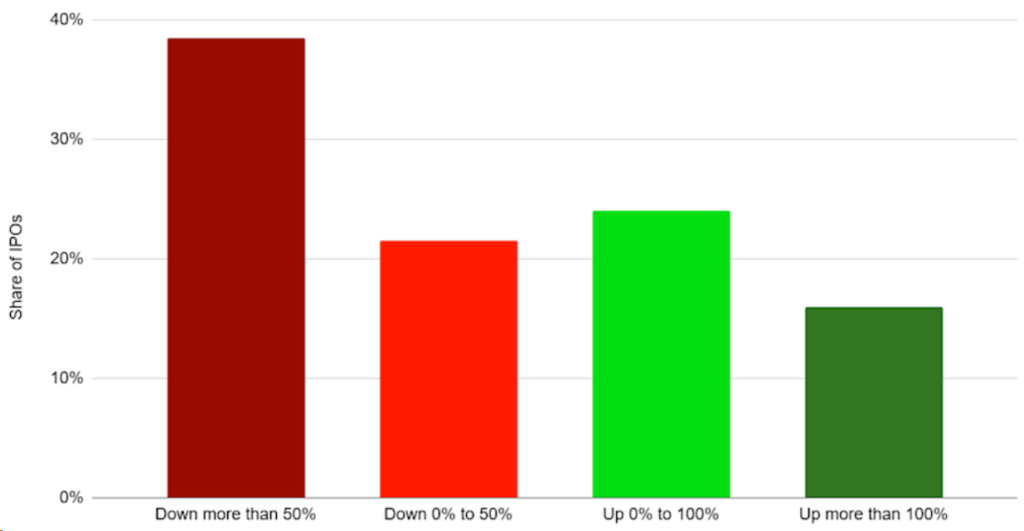
Source: Jay R. Ritter, University of Florida, Yahoo Finance analysis. Based on 9,195 operating-company IPOs from 1975 to 2021. Median three-year return after the first close was -25.7%, versus and average of +21.2%, lifted by a small group of big winners.
As always, Dynamic recommends staying balanced, diversified and invested. Despite short-term market pullbacks, it’s more important than ever to focus on the long-term, improving the chances for investors to reach their goals.
Should you need help navigating client concerns, don’t hesitate to reach out to Dynamic’s Asset Management team at (877) 257-3840, ext. 4 or investmentmanagement@dynamicadvisorsolutions.com.
Disclosures
This commentary is provided for informational and educational purposes only. The information, analysis and opinions expressed herein reflect our judgment and opinions as of the date of writing and are subject to change at any time without notice. This is not intended to be used as a general guide to investing, or as a source of any specific recommendation, and it makes no implied or expressed recommendations concerning the manner in which clients’ accounts should or would be handled, as appropriate strategies depend on the client’s specific objectives.
This commentary is not intended to constitute legal, tax, securities or investment advice or a recommended course of action in any given situation. Investors should not assume that investments in any security, asset class, sector, market, or strategy discussed herein will be profitable and no representations are made that clients will be able to achieve a certain level of performance, or avoid loss.
All investments carry a certain risk and there is no assurance that an investment will provide positive performance over any period of time. Information obtained from third party resources are believed to be reliable but not guaranteed as to its accuracy or reliability. These materials do not purport to contain all the relevant information that investors may wish to consider in making investment decisions and is not intended to be a substitute for exercising independent judgment. Any statements regarding future events constitute only subjective views or beliefs, are not guarantees or projections of performance, should not be relied on, are subject to change due to a variety of factors, including fluctuating market conditions, and involve inherent risks and uncertainties, both general and specific, many of which cannot be predicted or quantified and are beyond our control. Future results could differ materially and no assurance is given that these statements or assumptions are now or will prove to be accurate or complete in any way.
Past performance is not a guarantee or a reliable indicator of future results. Investing in the markets is subject to certain risks including market, interest rate, issuer, credit and inflation risk; investments may be worth more or less than the original cost when redeemed.
Investment advisory services are offered through Dynamic Advisor Solutions, LLC, dba Dynamic Wealth Advisors, an SEC registered investment advisor.
Photo: Adobe Stock