

By Dynamic’s Asset Management Team
Download the 07.24.26 Dynamic Portfolio Perspectives for advisors’ use with clients
An initial public offering isn’t just a market event; it’s a milestone in a company’s growth story.
Whether it’s a founder-led business entering the public markets, a high-growth technology company raising capital, or a well-known private brand becoming available to everyday investors, an IPO often generates excitement, headlines and investor interest.
However, excitement can also create risk. When a newly public company begins trading, investors are often making decisions with limited public history, uncertain valuation expectations and heightened volatility. The key is not simply deciding whether an IPO is “good” or “bad,” but understanding how IPOs work, what risks they carry and how they may fit within a long-term investment strategy.
What Is an IPO?
An initial public offering, or IPO, is the process by which a private company offers shares to the public for the first time. Once the IPO is complete, the company’s shares begin trading on a public stock exchange, allowing individual and institutional investors to buy and sell ownership in the company.
Companies pursue IPOs for several reasons, including:
- Raising capital to fund growth
- Providing liquidity for founders, employees or early investors
- Increasing brand visibility and credibility
- Using publicly traded shares for acquisitions or employee compensation
- Creating a broader market for company ownership
For investors, IPOs can provide access to companies earlier in their public-market life cycle. But that access also comes with uncertainty.
The Risks of Investing in IPOs
The most obvious risk is volatility. IPO stocks can experience significant price swings in the days, weeks and months after going public. Initial demand, media attention and limited trading history can all contribute to rapid moves in either direction.
There’s also valuation risk. Many companies go public with strong growth narratives, but those expectations may already be reflected in the IPO price. If future results don’t meet investor expectations, the stock may decline sharply.
History reinforces that point. Based on data evaluating more than 9,000 operating-company IPOs from 1975 through 2021, the median three-year return after buying at the first closing price was negative. In fact, 60% of IPOs were either flat or down three years later, and nearly 40% were down more than 50%.
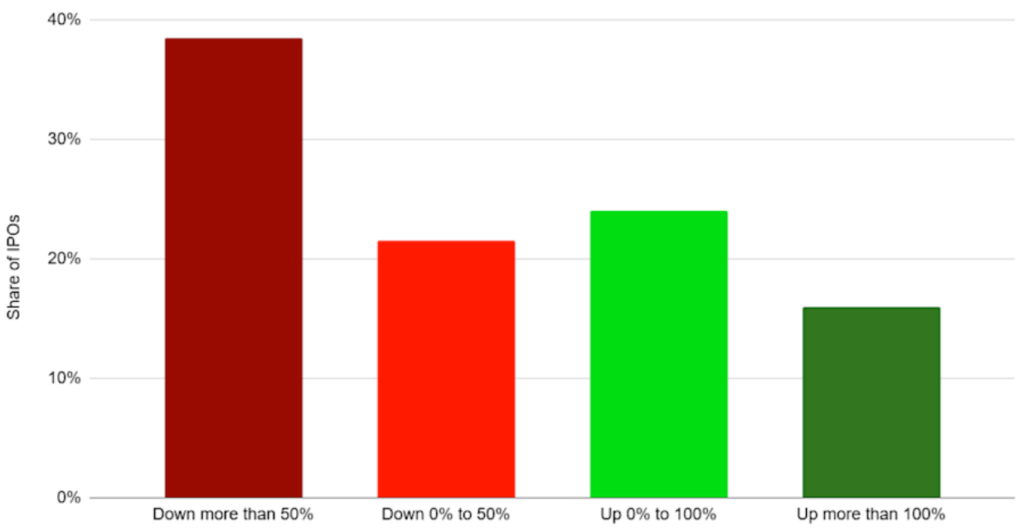
Source: Jay R. Ritter, University of Florida, Yahoo Finance analysis. Based on 9,195 operating-company IPOs from 1975 to 2021.
Median three-year return after the first close was -25.7%, versus an average of +21.2%, lifted by a small group of big winners.
That doesn’t mean IPOs never work. Some can be exceptional long-term winners. But the distribution of outcomes is highly uneven, with a small group of major successes lifting average returns while many others struggle to meet expectations.
Investors should also consider the limited operating history available in public markets. While IPO prospectuses provide important financial information, newly public companies typically have not yet been tested by quarterly earnings expectations, public shareholder scrutiny or changing market cycles.
Lock-up periods can introduce another challenge. In many IPOs, insiders and early investors are restricted from selling shares for a set period after the offering. When those restrictions expire, additional shares may enter the market, potentially putting pressure on the stock price.
The result is often a gap between the story investors are excited about and the fundamentals needed to support long-term returns.
3 Ways to Thoughtfully Approach IPO Investing
The good news: Investors don’t need to approach IPOs with an all-or-nothing mindset. Here are three ways to thoughtfully evaluate IPO opportunities:
1. Separate Hype from Fundamentals
IPOs often come with compelling narratives. A company may have a visionary founder, a recognizable brand, exciting technology or a large addressable market. Those qualities can be important, but they are not the same as investment discipline.
Before investing, it’s important to understand how the company makes money, whether it is profitable, how quickly it is growing and what competitive advantages it may have. Investors should also evaluate the company’s balance sheet, leadership team, cash flow profile and path to sustainable earnings.
Some companies may have one profitable business segment while other parts of the company remain unproven or loss-generating. Others may be valued based on ambitious projections that could take years to materialize — if they materialize at all.
A compelling story can create excitement. Durable fundamentals are what ultimately determine long-term investment outcomes.
2. Be Patient with Entry Points
IPO enthusiasm can drive prices higher quickly, especially when demand is strong. But the first trading day isn’t always the best time to buy.
Newly public companies often experience volatility as the market works to establish a fair value. Waiting for earnings reports, updated guidance or a more attractive valuation can give investors better information before committing capital.
This is especially important because IPO pricing can reflect strong demand before public investors have much time to evaluate the company’s results. In some cases, the initial price may already assume significant future success.
For many investors, patience can be a risk-management tool. The opportunity to invest in a company does not disappear simply because an investor chooses not to buy on day one.
3. Let Diversification Do Its Job
Even when an IPO appears attractive, position sizing matters.
Because newly public companies can be more volatile and less proven than established public companies, IPO investments should generally be considered within the context of a diversified portfolio. A small allocation may provide exposure to potential upside while limiting the impact if the stock underperforms.
It’s also worth noting that many investors gain exposure to successful IPOs over time without buying them directly. As newly public companies grow, they may eventually be included in major indexes, mutual funds and ETFs. That means diversified investors may participate in the growth of IPO companies in a more balanced and risk-managed way.
In other words, investors do not need to chase every new offering to benefit from innovation and business growth.
IPO investing should complement a broader plan, not dominate it.
Turn Excitement into Discipline
An IPO can represent innovation, growth and opportunity. It can also represent uncertainty, volatility and elevated expectations.
Investing in IPOs isn’t about chasing headlines or giving in to fear of missing out. It’s about evaluating whether a newly public company fits the investor’s goals, risk tolerance, time horizon and overall portfolio strategy.
Some IPOs may go on to deliver extraordinary returns. Many will not. The challenge is that identifying the long-term winners early can be difficult, especially when information is limited and investor enthusiasm is high.
At Dynamic, we work with advisors to help evaluate investment opportunities within the context of a client’s full financial picture. The right approach depends on the company, valuation, portfolio construction, liquidity needs and the investor’s willingness to tolerate volatility.
With thoughtful planning, IPOs can move from a source of excitement to a disciplined component of long-term wealth strategy.
Invest with intention.
Let’s talk about how we can support your clients’ success.
Contact Dynamic’s Asset Management team at (877) 257-3840, ext. 4 or assetmanagement@dynamicadvisorsolutions.com.
Disclosures
For advisor use only. This commentary is provided for informational and educational purposes only. The information, analysis and opinions expressed herein reflect our judgment and opinions as of the date of writing and are subject to change at any time without notice. This is not intended to be used as a general guide to investing, or as a source of any specific recommendation, and it makes no implied or expressed recommendations concerning the manner in which clients’ accounts should or would be handled, as appropriate strategies depend on the client’s specific objectives.
This commentary is not intended to constitute legal, tax, securities or investment advice or a recommended course of action in any given situation. Investors should not assume that investments in any security, asset class, sector, market, or strategy discussed herein will be profitable and no representations are made that clients will be able to achieve a certain level of performance, or avoid loss.
All investments carry a certain risk and there is no assurance that an investment will provide positive performance over any period of time. Information obtained from third party resources are believed to be reliable but not guaranteed as to its accuracy or reliability. These materials do not purport to contain all the relevant information that investors may wish to consider in making investment decisions and is not intended to be a substitute for exercising independent judgment. Any statements regarding future events constitute only subjective views or beliefs, are not guarantees or projections of performance, should not be relied on, are subject to change due to a variety of factors, including fluctuating market conditions, and involve inherent risks and uncertainties, both general and specific, many of which cannot be predicted or quantified and are beyond our control. Future results could differ materially and no assurance is given that these statements or assumptions are now or will prove to be accurate or complete in any way.
Past performance is not a guarantee or a reliable indicator of future results. Investing in the markets is subject to certain risks including market, interest rate, issuer, credit and inflation risk; investments may be worth more or less than the original cost when redeemed.
To the extent that this material concerns tax matters, it is not intended to be used by a taxpayer as tax advice. Each taxpayer should seek independent advice from a tax professional based on his or her individual circumstances.
Investment advisory services are offered through Dynamic Advisor Solutions, LLC, dba Dynamic Wealth Advisors, an SEC registered investment advisor.
Photo: Adobe Stock